Sinaing na Tulingan
Small tuna gently braised with dried kamias and pork belly in our Batangas-style home version.
Prep: 25 minutes · Cook: 3 hours 15 minutes–4 hours 15 minutes · Rest: 10 minutes · Total: about 3 hours 50 minutes–4 hours 50 minutes.
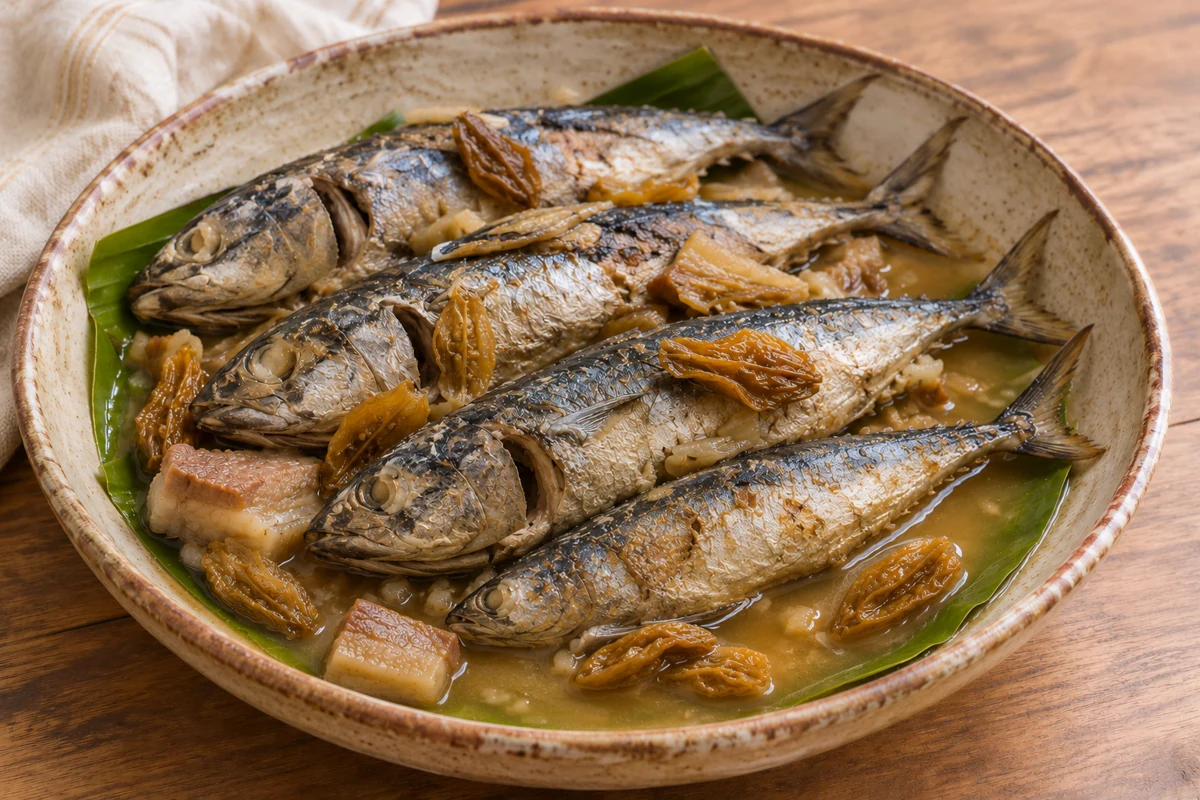
AI-generated serving illustration.
Equipment
Use a heavy, nonreactive 22 cm saucepan with a close-fitting lid, broad enough for the fish to sit snugly in one layer. A much wider pot evaporates liquid faster. Check the pot regularly throughout cooking.
Ingredients
Measure and prepare everything before you begin cooking.
- 1 kg cleaned small tulingan, preferably 4 bullet tuna or frigate tuna about 20–25 cm long; gills and innards removed
- 25 g dried kamias, briefly rinsed and drained
- 6 g fine salt, divided: 4 g for fish and up to 2 g for final seasoning
- 80 g unsalted pork belly, cut into 5 mm slices
- 600 ml water to start, plus up to 600 ml hot water reserved for topping up
- Optional: clean food-grade banana leaf to line the base, trimmed so it cannot reach the flame
- Cooked rice and sliced fresh tomatoes, to serve separately
Instructions
- 1
Keep the fish cold. Buy tulingan from a reliable chilled or frozen supply and thaw frozen fish in the refrigerator. Check that gills and innards are removed. Pat dry, make one shallow score on each side and rub with the initial 4 g salt. Gently press the fish with the flat of your hand to flatten slightly without breaking it. Keep chilled while preparing the pot. Tail trimming is a preparation preference, not a food-safety treatment.
- 2
Line and layer. If using banana leaf, wash it, soften briefly in hot water, dry and trim to fit the base. Lay pork belly over the base or leaf, then half the dried kamias. Arrange fish snugly in one layer and scatter remaining kamias over it.
- 3
Add measured water. Pour in the initial 600 ml water. It should reach roughly halfway to two-thirds up the fish in the specified pot. If the pot's shape leaves the level lower, add reserve water in 50 ml amounts until it reaches that level; do not force a one-layer arrangement into an unsuitable pot or submerge the fish under unnecessary water.
- 4
Bring to a gentle simmer. Set over medium heat for about 10–15 minutes, then lower the heat as soon as it simmers. Cover and maintain only small, occasional bubbles. Avoid a rolling boil. Begin the slow-cooking time once this gentle simmer is established.
- 5
Cook slowly. Simmer very gently for about 3–4 hours. Check every 20–30 minutes. Do not stir or turn the fish; gently tilt the pot if needed. Add reserve hot water in 50–100 ml amounts whenever the liquid threatens to fall below about 1 cm over the base. Burner heat and lid fit affect evaporation. If all the measured reserve is used before cooking is finished, add more hot water as needed and lower the heat; never let the fish scorch to meet a fixed water allowance.
- 6
Check before reducing. The thickest flesh should be opaque, flake readily and reach at least 63°C. During the long braise the pork belly should also be fully cooked and tender. Continue gently if needed. The extended cooking develops the preparation's texture and concentrated flavour; it does not establish that the bones are edible.
- 7
Keep a little liquid. Near the end, leave about 150–250 ml cooking liquid as a guide. If there is considerably more, partly uncover for the last 15–20 minutes while monitoring the base. If already low, keep covered and add a little hot water. Taste a spoonful and use any of the reserved salt only if needed. Do not reduce to a dry, salty crust.
- 8
Lift carefully. Rest covered off the heat for 10 minutes. Use a broad spatula to lift the fish. Serve with a little of the cooking liquid, rice and fresh tomatoes. Remove bones carefully as you eat; do not assume the long braise makes them safe to swallow. Banana leaf is not eaten.
About Sinaing na Tulingan
In Batangas cooking, sinaing na tulingan is a reason to let the pot take its time. Small tuna gently cooks with sour kamias and salt, with some households adding pork fat. Our version uses dried kamias and a heavy saucepan rather than requiring a clay pot. The aim is firm, tender fish and a little concentrated cooking liquid—not a dry pot or a promise that every bone will soften.
Ingredient swaps wherever you cook
- Look for frozen tulingan and dried kamias at Filipino grocers. Confirm the fish on the label rather than assuming every product called bonito is the same small fish.
- Large tuna steaks, mackerel and kahawai are not direct replacements for this fish size and four-hour method. They require a separate adaptation; do not keep the same timing under the tulingan name.
- Fresh kamias and tamarind differ in strength and water content. Neither has a verified gram-for-gram swap in this formula. If dried kamias is unavailable, choose another fish recipe rather than improvising the souring ratio on a published card.
- You can omit pork belly for a pork-free pot, but expect a leaner result. Monitor the liquid and base especially carefully. Do not label the published version pork-free while the listed pork remains in it.
How to know it is ready
- Fish flesh is opaque, flakes readily and reaches at least 63°C; pork belly is fully cooked and tender.
- Retain a little cooking liquid; remove bones rather than assuming the long braise makes them edible.
Common mistakes and fixes
- Fish breaks apart: lower the simmer and avoid stirring.
- Base catches: top up with hot water and check more often; a heavy pot helps.
- Too salty: weigh the salt and keep the final portion optional; further reduction makes saltiness stronger.
- Bones remain firm: remove them—this is not a pressure-canning method and edible bones are not a promised endpoint.
Family and regional variations
- Omit pork belly for a leaner pork-free adaptation, watching the liquid and base carefully.
Storage and reheating
Salt and kamias do not make this dish shelf-stable. Transfer leftovers to shallow containers and refrigerate promptly, within 2 hours; use within 2 days. Reheat once to above 75°C throughout. Keep the raw fish cold before cooking: cooking or freezing cannot remove histamine that has already formed from poor handling. Contains fish and pork.
What to serve with it
Makes 4 servings with separately cooked rice and sliced tomatoes. Contains fish and pork in this version. Spoon measures: 1 tablespoon = 15 ml; 1 teaspoon = 5 ml.
Sinaing na Tulingan FAQs
How do I know it is ready?
Fish flesh is opaque, flakes readily and reaches at least 63°C; pork belly is fully cooked and tender. Retain a little cooking liquid; remove bones rather than assuming the long braise makes them edible.
What should I check when buying ingredients overseas?
Look for frozen tulingan and dried kamias at Filipino grocers. Confirm the fish on the label rather than assuming every product called bonito is the same small fish. Large tuna steaks, mackerel and kahawai are not direct replacements for this fish size and four-hour method. They require a separate adaptation; do not keep the same timing under the tulingan name.
Cooking guidance: Follow current food-safety advice and the instructions for your equipment.